Every sea trout angler has a box full of “sure-fire” lures. And yet most fish are caught on just a few favourites. The lure matters, but what matters even more is where, how and at what speed you move it through the water.
Composite lure
Long and slim, usually 15–25 g, it casts a long way and swims well in shallow water. For many shore anglers it is the main lure.
- Pros: long casts, lively action, works at different depths.
- Use it: on windy days, when you need to cast far, and when the fish are feeding on sand eels, small Baltic herring or sticklebacks.
Metal lure
The classic metal lure is simple, cheap and effective. It imitates Baltic herring, smelt or a small trout.
- Pros: works all season long.
Fly
Fly fishing for sea trout is an art in itself. It takes more practice, but gives a very natural presentation. Flies imitating shrimp, amphipods or small fish are the main ones on the coast.
- Pros: quiet, natural, especially effective in calm, clear water.
- Use it: on still days, in shallow water, at dusk.
Colour — does it matter?
Every angler has their own theory about colour. My experience comes down to a simple rule:
- clear water and bright weather — more natural shades: silver, blue, green, a black back;
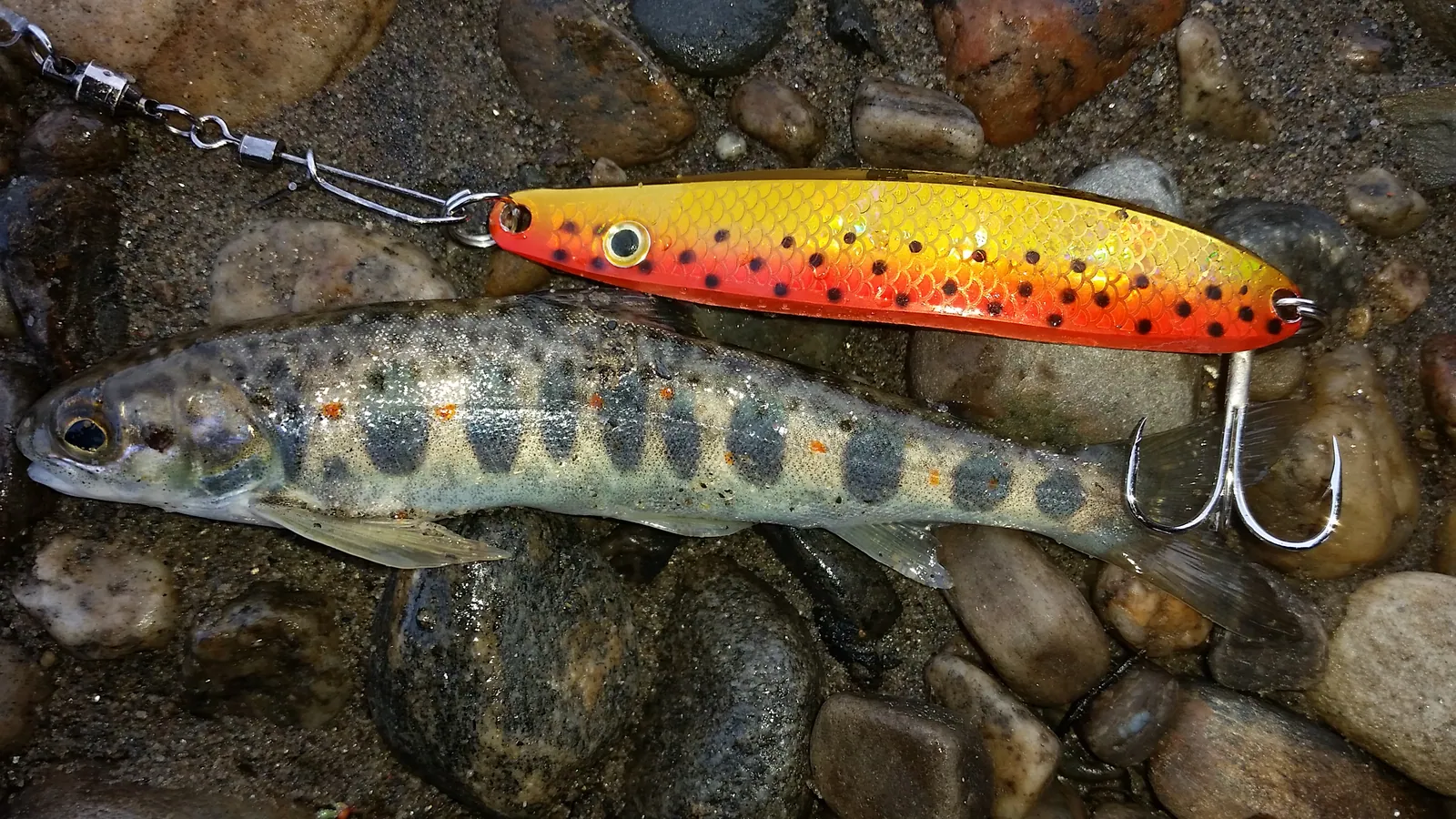
- coloured water and overcast weather — brighter shades: red, orange, yellow, pink;
- when nothing works — switch to something completely different and change your speed.
In the gallery there is a photo of a red-and-yellow spotted lure lying next to a fish. Anglers have loved colour combinations like that for decades — and not without reason.
Line and leader
A thin braided line gives long casts and good feel. On the end of it, tie roughly a metre of fluorocarbon leader, which is less visible in the water and more resistant to rocks. Check your knots and hooks — a sharp hook makes the day.
Most important of all: speed and pauses
The same lure can do nothing or be deadly — depending on how you retrieve it. Try:
- a steady, slow retrieve;
- bursts of speed and stops;
- letting the lure sink after the cast;
- retrieving while moving the rod sideways.
If a fish follows but doesn't take, change something — speed, depth, direction. We practise all of this on the guided day too. If needed, I can arrange extra gear — just ask.